

Selling a home in Italy: the documents you need (Florence guide)
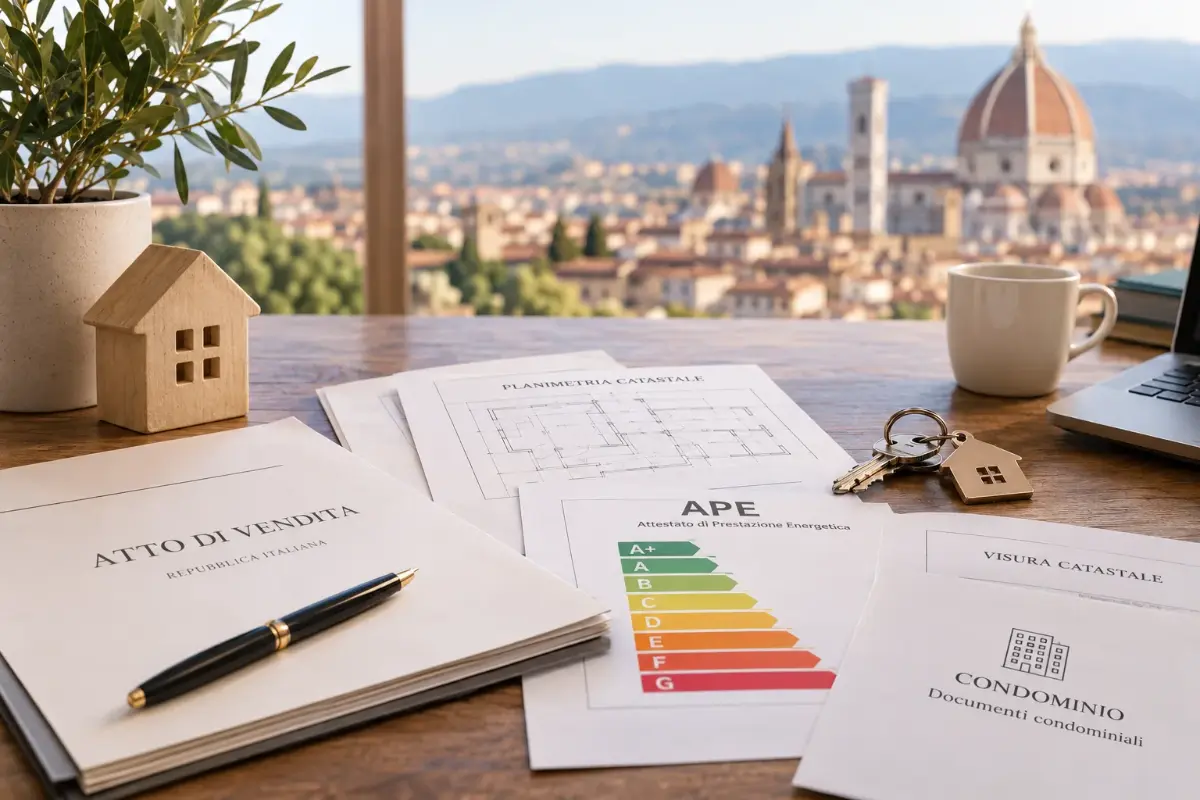
The documents you need to sell a home in Italy, who provides them and when to have them ready, plus what foreign owners should know when selling from abroad.
To sell a home in Italy you need three groups of documents: your personal documents as the seller, the documents about the property (how you acquired it, its cadastral records, its building permits, its energy certificate) and, if the home is in an apartment building, the documents from the building's management. Getting them ready before you put the property on the market avoids delays between accepting an offer and signing the rogito, the final deed of sale signed in front of a notary.
In Italy the notary is a public official who handles every property sale and checks that everything is in order. Here is what you will need, who provides each document and when to have it ready.
Which documents do you need to sell a home in Italy?
Here is the essential checklist. You probably have some of these documents already; others can be obtained online or from a technician. The notary checks everything before the deed.
Document | What it is for | Who provides it | When to have it ready |
|---|---|---|---|
ID and Italian tax code (codice fiscale) | Identifying the seller | Seller | Offer and deed |
Marriage certificate extract | Showing your property regime as a couple | Seller (from the town hall) | Deed |
Deed of acquisition (atto di provenienza) | Proving how you became the owner | Seller, or the notary who drew it up | Before accepting an offer |
Cadastral record and floor plan (visura and planimetria catastale) | Identifying the property and its layout | Seller, online from the Agenzia delle Entrate | Before listing |
Building permits and habitability (agibilità) | Proving the property complies with planning rules | Seller, town hall or technician | Before accepting an offer |
APE energy certificate | Stating the energy class | Qualified technician | Before listing |
Certificates of conformity for the systems | Documenting electrical, gas and heating systems | Seller, if available | Before the deed |
Building (condominio) documents | Fees, rules, approved works | Building administrator | Before accepting an offer |
Mortgage and lien searches | Checking for mortgages or charges | Notary | Before the deed |
Which personal documents does the seller need?
At the deed, every seller shows a valid ID and their Italian tax code (codice fiscale). If the property has several owners, all of them need their documents and all must sign, in person or through a notarial power of attorney.
If you are married, the notary will ask for an extract of your marriage certificate, which shows your property regime. Under the Italian "community of property" regime (comunione dei beni), depending on how and when the property was bought, your spouse may also need to take part. If the seller is a company, the notary will need its registration certificate (visura camerale) and proof of the signatory's powers.
Which documents do you need about the property?
The deed of acquisition
This is the deed through which you became the owner: a purchase deed, a gift or an inheritance. The notary uses it to trace the property's ownership history. If you don't have a copy, you can ask the notary who drew it up.
Cadastral record and floor plan
In Italy every property is registered in the catasto, the national property register. The cadastral record (visura catastale) contains the property's identification data and its registered owners; the floor plan (planimetria catastale) is the drawing of the home filed with the register. Owners can view both free of charge online, through their personal area on the Agenzia delle Entrate (Italian Revenue Agency) website, and can also authorise an estate agent online to view the floor plan.
These documents are crucial. In the deed, the seller must declare that the cadastral data and floor plan match the property as it actually is, and the floor plan is attached to the deed. If this declaration is missing, the deed is void. It can be replaced by a certificate of conformity from a qualified technician.
So it is worth comparing the floor plan with the real home before you list it. A moved wall, an added bathroom or an enclosed veranda must be regularised with a cadastral update, which requires a technician.
Mortgages and liens
Mortgage and lien searches show whether the property is subject to mortgages, seizures or other charges. The notary normally checks these before the deed. If you already know there is a mortgage, for example a loan you are still repaying, say so from the start: see the special cases below.
Why check planning compliance before selling?
Cadastral conformity concerns the property register, which is used for tax and identification purposes. Planning compliance is different: it concerns the building permits issued by the town hall. A correct cadastral floor plan does not guarantee that the home complies with planning rules.
For the deed, the notary asks for the details of the property's building permits, such as licences, permits or amnesties (sanatorie). If work was done over the years without the necessary paperwork, discrepancies may come to light that slow the sale down, or stop it until they are regularised.
Our practical advice is to have a technician (a geometra, architect or engineer) check the situation before you accept an offer, retrieving the permits from the town hall. The same check covers the certificate of habitability (agibilità). In Florence, where many homes are in historic buildings, this is a check worth doing early.
Are the APE and system certificates required?
The APE (Attestato di Prestazione Energetica, Italy's energy performance certificate) is required to sell, and the energy class must already appear in the property ad. So it is best to have it prepared before listing. We have a dedicated guide on what it shows and how long it lasts: APE energy certificate in Italy: what it is and when you need it.
For the electrical, gas and heating systems, it helps to have the certificates of conformity issued by whoever installed or modified them. If they are missing, discuss it with the notary and the buyer from the start, so it is clarified before the deed.
Which documents do you need if the home is in an apartment building?
In Italy, an apartment building is run as a condominio, with an administrator who manages shared costs. Buyers want to know what the home costs to run and whether expenses are coming up. Ask the administrator for:
a statement confirming you are up to date with the condominio fees;
the building rules (regolamento di condominio), if there are any;
the minutes of any approved extraordinary works, so you can agree with the buyer who will pay for them.
Special cases: inherited, mortgaged or rented homes
An inherited home
If you inherited the home, in addition to the documents above you will need those proving that ownership passed to the heirs, starting with the inheritance declaration (dichiarazione di successione). The notary also checks that the inheritance has been formally accepted. If there are several heirs, all of them must sign to sell the whole property.
A home with an outstanding mortgage
You can sell a home with a mortgage still to repay. Ask your bank for a redemption statement: usually the loan is paid off with part of the sale price at the deed, and the mortgage is then cancelled. The notary coordinates these steps with the bank.
A rented home
If the property is let, you will need the registered rental contract and information on the payments. The buyer must know from the start whether they are buying a vacant home or one with a tenant, and on what terms.
Selling from abroad: what foreign owners should know
Many owners of homes in Florence live abroad. You can still sell without difficulty, but keep these points in mind:
Tax code. You will need your Italian tax code (codice fiscale), the same one used when you bought.
You don't have to travel. You can sign through a power of attorney (procura) given to someone you trust in Italy. If you sign it abroad, it generally has to be legalised or apostilled to be valid in Italy: the notary will tell you the exact form required.
Language. Notarial deeds in Italy are written in Italian. If you don't understand Italian, the deed can be drawn up in a foreign language known to the notary and witnesses, or signed with an interpreter who provides a translation. Tell the notary in advance.
Taxes. Any tax due on the sale depends on your personal situation and tax residence: check with the notary or an accountant before you sign.
Having everything ready before you list makes the sale smoother and gives buyers confidence. If you are thinking of selling in Florence or the areas where we work, you can propose your property to us, or find out more about our services for sellers.
The information in this article is general and up to date as of October 2026. Every case should be checked with the notary and, for technical matters, with a qualified technician.
Frequently asked questions
Can I sell if the cadastral floor plan doesn't match the real home?
Not until it is regularized. In the deed the seller must declare that the cadastral data and floor plan match the property as it is; if they don't, a technician must file a cadastral update first.
Who has to obtain the documents for the sale?
The seller, for both personal and property documents. The notary still carries out up-to-date cadastral and mortgage checks before the deed.
Where can I get the cadastral record and floor plan?
Owners can view them free of charge online, in their personal area on the Agenzia delle Entrate website, or authorise an estate agent online to view the floor plan.
Can I sell an inherited home?
Yes. Besides the usual documents, you need those proving the transfer to the heirs, such as the inheritance declaration, and the notary checks that the inheritance was accepted. If there are several heirs, all must sign to sell the whole property.
Can I sell without being in Italy?
Yes, through a notarial power of attorney given to someone you trust. If it is signed abroad, it generally needs to be legalised or apostilled: the notary will tell you the correct form.